
Digital Marketing in China: The Channels That Matter and 7 Trends Updated for 2026
Updated on |By QPSoftware
Digital marketing in China runs on Chinese platforms, because Google, Facebook and YouTube are blocked in mainland China. Brands reach consumers through WeChat, Douyin, Kuaishou, Xiaohongshu, Baidu and e-commerce marketplaces, using live streaming, creators and WeChat communities. The seven trends below, first listed in 2021, show where online marketing in China has gone since.
Key takeaways
- Google, Facebook, YouTube and X are blocked in mainland China: campaigns run on Chinese platforms.
- WeChat is the base of most strategies: Weixin and WeChat had 1.439 billion monthly active users in June 2026 (Tencent).
- Live streaming is now mainstream rather than new: 813.59 million users in December 2025, slightly fewer than a year earlier (CNNIC).
- Lower-tier and rural markets keep growing online: rural China had 314 million internet users in December 2025 (CNNIC).
- Recommendations from everyday users (KOCs) now sit next to KOL campaigns, and platforms run official marketplaces to find creators.
What Makes Digital Marketing in China Different?
The first difference is the platforms. Google, Facebook, YouTube and X are permanently blocked in mainland China, according to the UK government’s travel advice for China, so a plan built on Google Ads, Meta and YouTube does not reach Chinese consumers. Chinese platforms take their place, and most of them mix content, social features and shopping in a single app.
The second difference is the pace. China often pioneers marketing strategies that later become popular in Western countries. At other times, what works in China is foreign to the rest of the world and stays effective only with a Chinese audience. Nothing can be taken for granted when launching a marketing campaign in China: study the needs and habits of your specific audience before you choose channels.
The Main Digital Marketing Channels in China
| Channel | Type | Main marketing uses | Best for |
|---|---|---|---|
| Messaging super app | Official Account content, Mini Programs, Channels videos, ads | Owned audience, customer service, sales | |
| Douyin | Short video | In-feed ads, creator videos, live selling | Mass reach |
| Kuaishou | Short video and live streaming | Live selling, creator videos | Lower-tier cities |
| Xiaohongshu | Lifestyle notes and reviews | Creator seeding, feed and search ads | Product discovery |
| Bilibili | Video community | Sponsored videos, creator series | Young audiences |
| Baidu | Search engine | SEO, paid search | Search demand, B2B leads |
| Tmall, JD.com | E-commerce marketplaces | Brand stores, marketplace ads | Online sales |
Most foreign brands start with WeChat, because it combines content, customer service and sales in one app. As a WeChat development agency, we build the Mini Programs and WeChat stores that campaigns on the other channels lead to. B2B companies will find a channel-by-channel method in our guide to B2B marketing in China, and brands that plan video campaigns can compare Douyin, WeChat Channels and Bilibili in our guide to video marketing in China.
Online Marketing Trends in China: The 2021 List, Updated for 2026
When this article was updated at the start of 2021, we listed seven online marketing trends in China. Each trend below keeps what we wrote then, followed by where it stands in 2026.
1. Live Streaming Focused on High-Quality Content
In 2021, live-streaming campaigns kept attracting users, but the focus was switching from simple sales pitches to more entertaining and educational content.
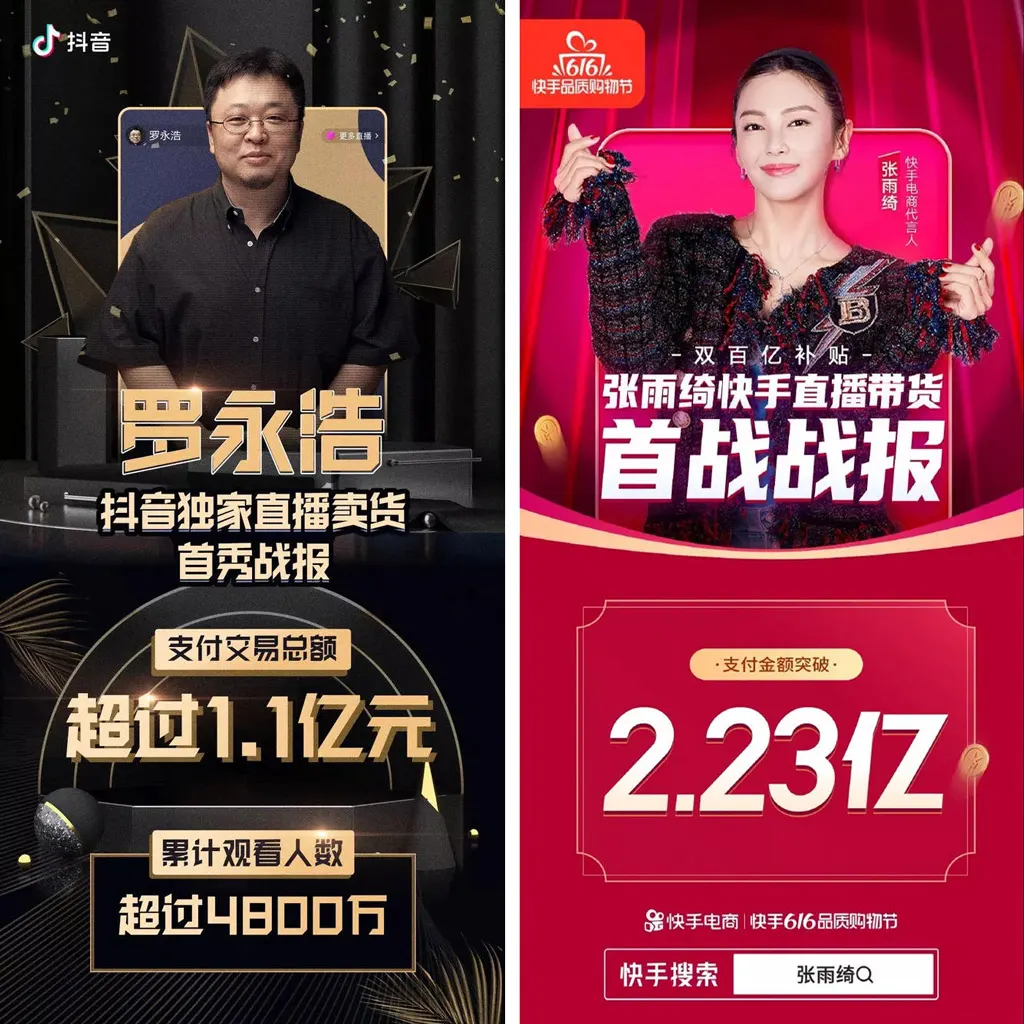
Results published by Douyin and Kuaishou after the first live-selling shows of Luo Yonghao and Zhang Yuqi: more than 110 million and 223 million yuan in payments.
Live-streaming campaigns needed to create excitement, which brands achieved by inviting famous hosts or trusted KOLs (Key Opinion Leaders) to represent them. Live streaming was focusing less on selling products and more on entertaining the audience, to increase likes, shares, comments and new users. Incentives given during the session were still effective, but the content had to be more creative and educational, instead of simply commercial.
Where it stands in 2026: live streaming is now a mainstream channel rather than a trend. China had 813.59 million live-streaming users in December 2025, 72.3% of internet users and slightly fewer than a year earlier, according to the 57th Statistical Report on China’s Internet Development of the China Internet Network Information Center (CNNIC). Educational formats found their audience too: in 2024, East Buy’s knowledge-based live-streaming room on Douyin achieved strong sales.
2. WeChat Groups Integrated With Smart Chatbots
In 2021, WeChat groups were a proven way to attract private traffic. Integrating them with a smart chatbot, even though it did not replace a human admin, made the tool more cost-effective and useful for companies.
The chatbot could be set to answer common questions, promote upcoming events, conduct surveys, collect information about the audience, recommend a product based on specific keywords, and more.
Where it stands in 2026: private traffic is still built on WeChat, and WeCom, Tencent’s platform for companies, is designed to run it: it connects employees with external customers and partners. In 2023, WeCom served 12 million enterprises and had more than 180 million monthly active users.
3. Douyin Turns to Educational Content
In 2021, Douyin, the Chinese version of TikTok, had taken a large share of the social media scene. Known as the place to go for a good laugh, it was undergoing a major change in its content: users enjoyed using the platform in a more educational way, with how-to tips, advice and storytelling. That made Douyin a good platform where online marketers could promote products or educate their audience about them.
Where it stands in 2026: Douyin passed 680 million daily active users in China in 2024 and now combines content with Douyin Shop and live-streaming sales. The completion rate of its knowledge-based paid courses remained high in 2024, which confirms the shift toward learning content.
4. WeChat Mini Programs
In 2021, WeChat Mini Programs had become a critical asset for online marketers. In just a few years, a huge number of companies had launched one, and other super apps such as Alipay and Baidu had built their own mini program platforms. Companies had to dedicate resources to launching or improving their WeChat Mini Programs, as users expected every serious company to have one.
Where it stands in 2026: Mini Programs are now a sales channel in their own right. Tencent’s results for the second quarter of 2026 credit the growth of its marketing services revenue, up 22% year on year to RMB 43.6 billion, partly to closed-loop marketing inside Weixin, which helps services such as Mini Shops and Mini Games advertise more effectively.
5. Lower-Tier Cities Become a Target
In 2021, Pinduoduo, an e-commerce platform where users join group-buying deals, had grown popular in lower-tier cities. This was a wake-up call for major companies like JD.com, which realized the potential of cities that marketing campaigns usually overlooked. Consumers in these areas have lower spending power, but their numbers made them a priority for many brands.
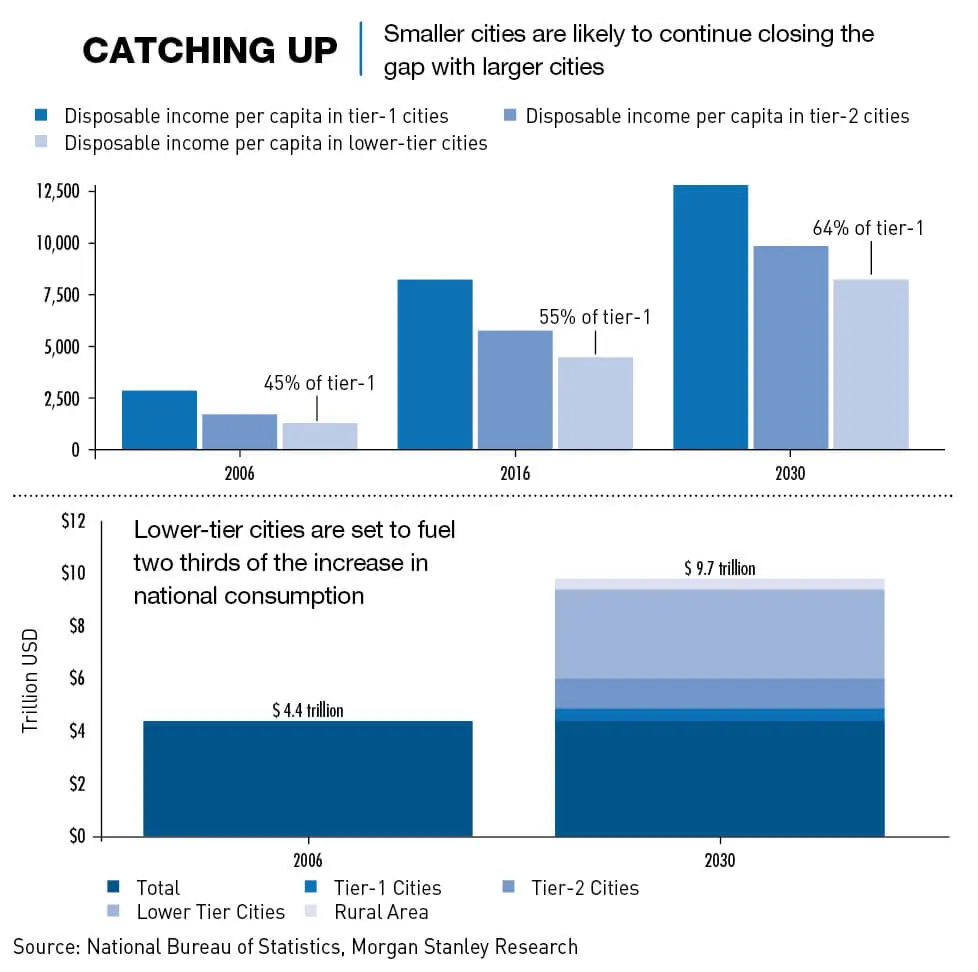
Forecast by Morgan Stanley Research, based on National Bureau of Statistics data, as shown in the 2021 version of this article.
Where it stands in 2026: rural China had 314 million internet users in December 2025, 27.9% of the total, and rural internet penetration reached 69.5%, up 2.2 points in a year, according to the same CNNIC report. CNNIC also notes that rural online retail sales grew from RMB 353 billion in 2015 to RMB 2.56 trillion in 2024, with e-commerce live streaming among the new formats that drive rural businesses.
6. Influencers Are Not Influencing as Much as Before
In 2021, influencers were still valuable, but people tended to trust them less than before, and micro-influencers were gaining popularity. People felt a need for credibility, and they did not always find it in influencers paid to promote products.
Consumers relied more on feedback from real users and turned to platforms where users share their experiences. WeChat, for instance, had launched Good Product Circle, a feature where users shared products from Mini Programs with their friends, recommended products based on their own experience or checked what their friends had bought.
The short video and live-streaming platform Kuaishou had introduced Small Store, a channel where users shared products from major online shops like JD.com, Taobao and Tmall with their friends. A click on a shared product led to the e-commerce website, where it could be bought directly. These platforms, where friends connect, provided the trust that many users did not find with influencers.
Where it stands in 2026: recommendations from everyday users, called KOCs (Key Opinion Consumers), are now a standard part of campaigns. Platforms run official marketplaces where brands find creators of every size, such as Xingtu (巨量星图) for Douyin and Pugongying (蒲公英) for Xiaohongshu.
7. A New Approach to KOLs
This trend was closely related to the previous one. KOLs (Key Opinion Leaders) were still relevant in online marketing, but the approach was changing significantly. Companies tended to sign contracts that made them the sole partner of a KOL.
The influencer would work with only one brand and promote it through their content, social media channels and e-commerce stores. In return, the company gave the KOL the support and training needed to become more efficient in personal branding.
Where it stands in 2026: exclusive partnerships sit next to other models, such as flat fees per post, commissions on sales and free product seeding for smaller creators. The right model depends on the creator’s tier and on whether the campaign aims at awareness or sales.
What Should You Do Next?
Digital marketing in China keeps changing, and the 2021 trends show how fast: live streaming became mainstream, everyday users became trusted voices, and Mini Programs turned into sales channels. What does not change is the need for a tight grip on local culture and consumer behavior, especially for marketers who are new to China.
Start with where your customers spend their time, then build the owned assets your campaigns lead to. For most foreign brands, that means a WeChat Official Account and a Mini Program or a WeChat store, the work of a WeChat agency that builds for foreign brands. If your buyers also search on Baidu, our China SEO team can optimize your website for it.
If you need assistance in planning your marketing strategy in China, call us today. QPSoftware has worked in the Chinese market since 2009, and we can help you prepare your campaigns.
Frequently Asked Questions
How do you do digital marketing in China?
Start by choosing Chinese platforms, since Google, Facebook and YouTube are blocked in mainland China. Most foreign brands build a base on WeChat (Official Account, Mini Program, Channels), add reach on Douyin, Kuaishou or Xiaohongshu with ads and creators, and cover search demand on Baidu. Content must be localized, not only translated, and ad accounts usually need a Chinese entity or a local partner.
What is the best way to advertise in China?
There is no single best channel. WeChat ads, including Moments ads, reach users inside the app they use every day. Douyin and Kuaishou sell in-feed ads and support live selling. Xiaohongshu offers feed and search ads alongside creator partnerships, and Baidu covers paid search. Choose based on where your audience spends its time and whether you want awareness, leads or sales.
Is Douyin or Kuaishou better for marketing in China?
It depends on your audience. Douyin is larger, with more than 680 million daily active users in China in 2024, and suits mass reach, performance ads and live selling. Kuaishou had more than 300 million daily active users in 2024 and is strongest in third- and fourth-tier cities and rural areas, where live-streaming sales rely on trust between streamers and their fans.
Are Google and Facebook ads available in China?
No. Google, Facebook, YouTube and X are blocked in mainland China, according to the UK government’s travel advice, so ads on these platforms do not reach consumers there. Campaigns aimed at Chinese consumers run on Chinese platforms such as WeChat, Douyin, Xiaohongshu and Baidu, usually through a Chinese entity or an authorized local partner.