
Chinese Web Design: Why Chinese Websites Look Different and the Trends to Follow
Updated on |By QPSoftware
Chinese web design packs more information on each page than Western design: dense menus, many links and descriptive previews, made for users who prefer to scan a page rather than search it. Since around 2018, Chinese websites have become cleaner, but they still show a lot upfront, and they are designed for phones first.
Key takeaways
- Chinese websites show more links, text and sub-menus than Western ones, a habit rooted in how Chinese users have long found content online.
- Minimalist layouts have spread since around 2018, but a page that looks empty can make users think a company is hiding something or has little to say.
- A 2016 Nielsen Norman Group study found that Chinese users are used to complex pages but take longer to find things on them, and benefit from simpler designs that are not oversimplified.
- Phones come first: 99.6% of Chinese internet users go online with a mobile phone (CNNIC, December 2025), and WeChat is part of the experience.
- Translating a Western website is not enough: navigation, content density and third-party services need to be adapted.
Knowing how Chinese website design works is especially important for Western companies expanding into this market. Translating your existing website into Chinese and hiring developers without guidance will not be enough: the structure and design of a Western website rarely match the habits and expectations of Chinese users.
This article does not try to decide whether Western or Chinese web design is better. Its aim is to help you understand how people in China perceive and use the web, so that your website appeals to a Chinese audience. For the best results, work with designers who know the local market, like the team of a web design company in Shanghai.

Why Is Chinese Web Design Different?
If you have browsed Chinese websites before, the number of links and the amount of text on a single page may have surprised you. Some Chinese sites still recall the crowded web pages of the early 2000s.
Many observers took this as a sign that Chinese web design had fallen behind. In reality, there are specific reasons for the differences between Western and Chinese web design.
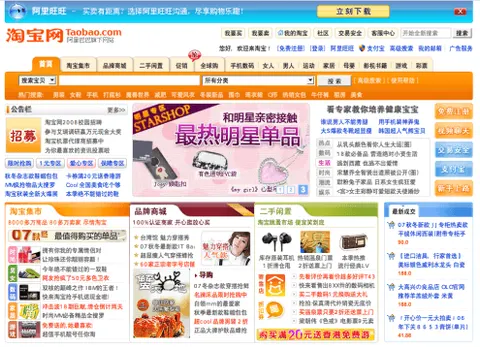
The first reason is the language, and the way search handles it. In English, typing a single word is often enough for a search function to find related content. Written Chinese has no spaces between words, and a word can be made of one or several characters, so search results have long been less precise. Web designers therefore put as much content as possible on a single page, so that users could explore it without searching.
Another factor slowed the evolution of Chinese web design: for years, many webmasters hesitated to explore new solutions. Many businesses simply copied successful websites, convinced that it was the only way to succeed, and new ideas were often rejected until major websites adopted them.
Over the past years, however, more and more Chinese web designers have moved to a cleaner, more minimalist design, as the trends below show.
Chinese Web Design Trends
We first described these Chinese web design trends in 2020. Where we could check what has changed since, the section says so.
Mobile First, Sometimes Mobile Only
Responsive design is a priority everywhere, but in China a mobile-first approach is the minimum. Design for the phone first, and ask whether your audience needs more than a light desktop version.
The figures explain why. CNNIC’s Internet Usage report (2017) already showed that 95.1% of Chinese internet users went online with a mobile device at the end of 2016. In its 57th Statistical Report on China’s Internet Development, published in March 2026, the China Internet Network Information Center (CNNIC) puts that share at 99.6% in December 2025.
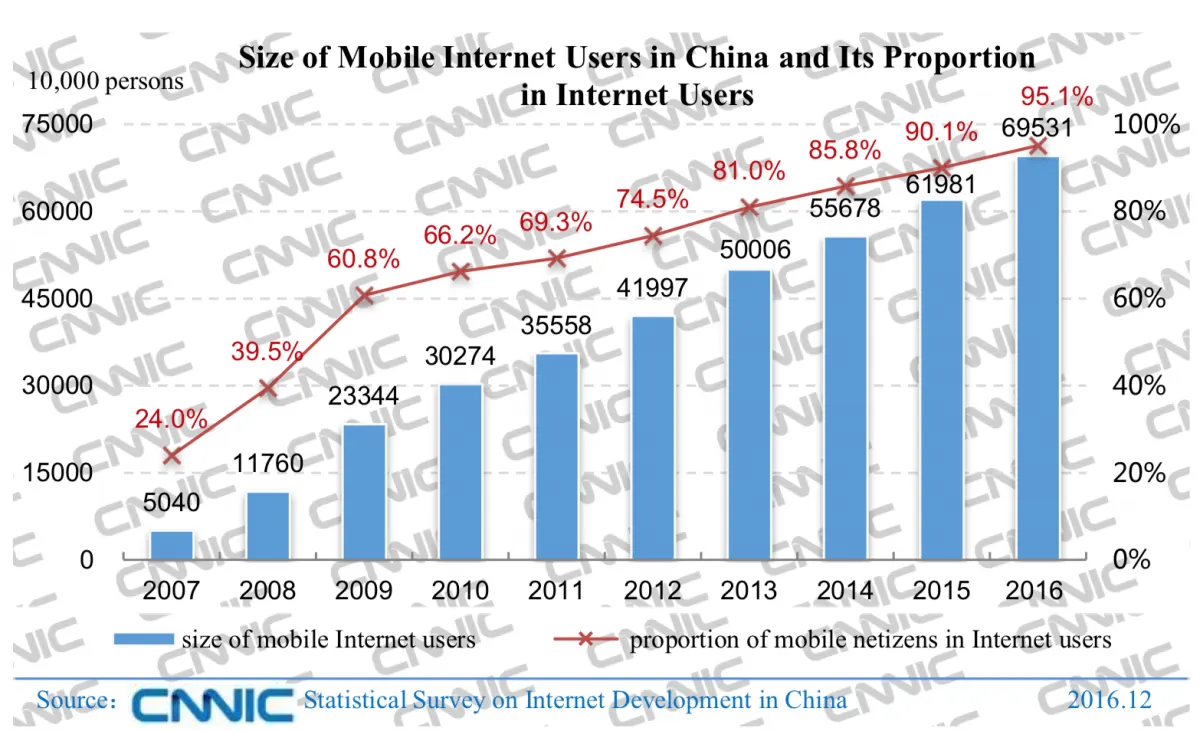
Expect your users to visit your website primarily from a phone, and focus your web design on that. Most major companies in China also run an Official WeChat Account connected to their business, another reason to think mobile first.
Minimalist Design, With Information Upfront
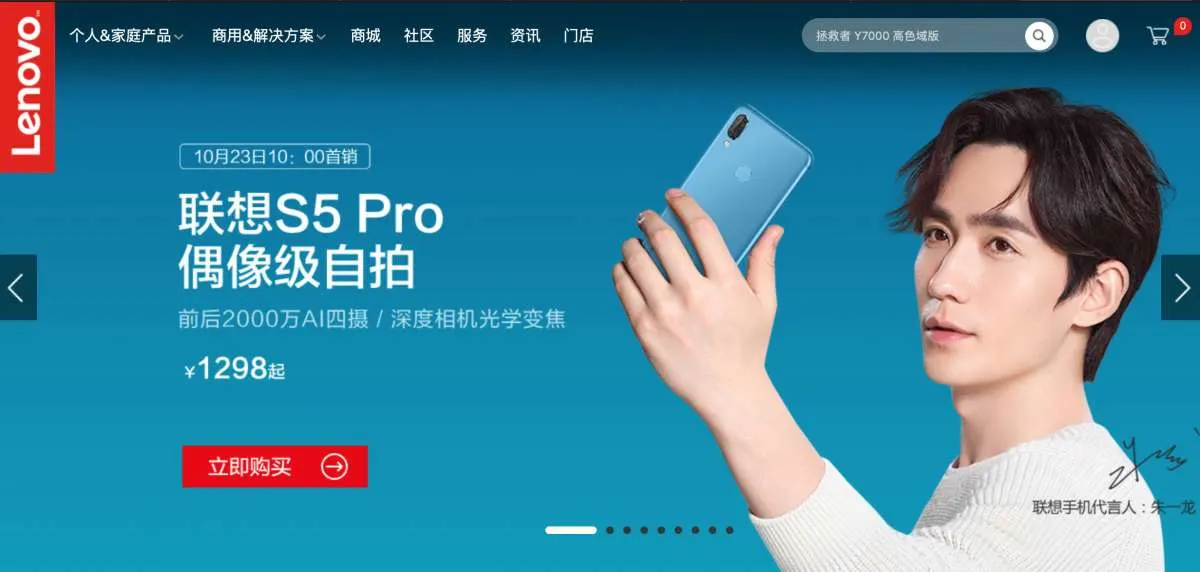
Since 2018, we have seen an increase in minimalist web design in China. Many businesses have followed the pattern set by large companies such as Lenovo, which redesigned its platform with a minimalist approach.
This marked a major change from crowded web pages to a more relaxed design, closer to what we see in the West. The habit of finding many links and a lot of information on a single page still shapes user behavior, though: Chinese users like to see as much information as possible upfront.
In a 2016 study, Are Chinese Websites Too Complex?, Nielsen Norman Group found that Chinese users were used to complex pages but took longer to find things on them. Its conclusion: a simpler design, but not an oversimplified or minimalist one, serves Chinese users better.
So web pages should not be too minimal, or users may think the company is hiding information or has little to say. Even in a minimalist layout, links and previews should be more descriptive than on Western websites, to build trust and give users the experience they expect.
Navigation Built for Scanning
User experience matters as much in China as in the West: navigation must be easy, intuitive and quick. A Chinese website must also follow some local habits.
Minimalist design has solved the problem of crowded, complicated pages, but the search issue described above remains. The design must give direct access to as much information as possible, for example with several levels of navigation that lead to short pages rather than long ones. Native Chinese websites make wide use of sub-menus and sub-sub-menus.
Navigation menus are usually organized horizontally rather than vertically, since a horizontal structure is easier to scan in Chinese. WeChat’s own design guidelines for Mini Programs follow the same logic: users should always know where they are and where they can go, with as little typing as possible.
If you are creating a Chinese version of an existing website, consider redesigning its navigation instead of copying the existing one. A method such as the Core Model, which designs a website from its core pages outward, helps you start from what Chinese users actually need.
Language needs the same care. Machine translation does not work well for Chinese, and a poor or incorrect translation hurts the credibility of your business and can even seem disrespectful. Hire a qualified copywriter fluent in Chinese to translate or, better, rewrite your content.
H5 Pages and WeChat
WeChat H5 pages became very popular in China. Users like to be entertained and to get a personalized experience, and H5 pages meet those needs.
This is especially true if you are planning a marketing campaign in China or want to engage your visitors more: an H5 page should then be in the pipeline. H5 pages are usually faster and cheaper to develop than other tools, and a project that needs more than a campaign can move on to WeChat Mini Program development.
H5 pages are highly interactive, which makes them popular for campaigns and a powerful tool to close sales. They also let you measure how visitors interact with your campaign, and adjust your marketing strategy accordingly.
Video Clips on Homepages
Videos are a primary tool to promote content on social media, and in 2019 we saw them spread to website homepages.
A homepage video does not need to be long. It can be a short clip of a few seconds, played on a loop. What matters is quality, and a clip that conveys one main idea quickly. Used well, videos increase the time users spend on your page and give you more opportunities to generate conversions.
In China, host the video file on your own server or on a Chinese video platform such as Youku or Bilibili, rather than embedding a player from a foreign platform.
Dark Mode
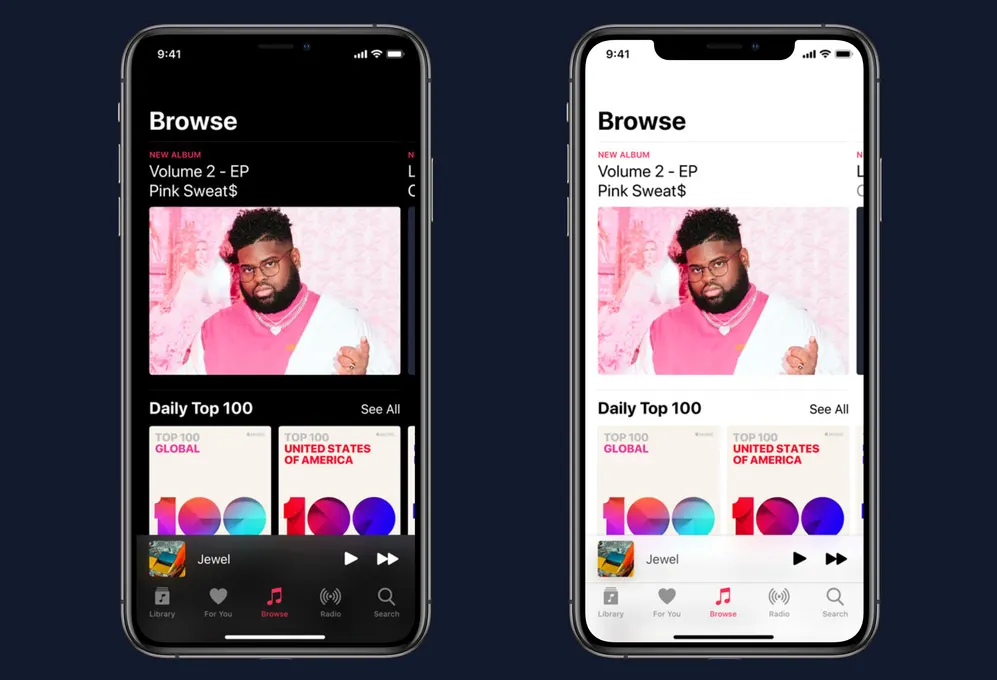
In 2020, dark mode was spreading in the West, and we expected it to gain traction in China as well. It did: WeChat has officially supported dark mode since version 7.0.12 on iOS and 7.0.13 on Android, and Mini Programs can adapt to it, according to WeChat’s Mini Program documentation on dark mode.
Especially on mobile, the choice between light and dark mode lets users customize their experience. A website, an H5 page or a Mini Program for China should therefore be tested in both modes.
Voice Search
Voice search lets users search content without typing: they speak to their device, and the results appear.
In 2020, voice search was a popular feature in China for a good reason: typing Chinese means choosing characters from a list of candidates, while speaking a query is simpler. Websites and apps that make voice input easy remove a real obstacle for their users.
Gradients

In 2020, gradients were another visible trend. They are not new in web design, but designers used them more to add visual impact and depth to a layout.
The question was how to keep the clarity of a minimalist design without boring users. The answer was to play more with visual elements: gradients in backgrounds, over images and illustrations, in buttons, calls to action and menus. Gradients are simple to use, create a strong visual effect and work well on both desktop and mobile, which made them useful in China.
Chinese Web Design in Practice: Two QPSoftware Projects
Two projects show how these principles translate into real websites.
For Duke Kunshan University, an international university jointly founded by Duke University and Wuhan University, QPSoftware revamped and redesigned the website. The design proposal favored simplicity in the details, clean lines and a clean design that prioritizes user experience, with a responsive, mobile-friendly and cross-browser site, HTML5 video, data migration and an event management system.
For Erno Laszlo’s brand website in China, launched in April 2020, QPSoftware built a WordPress site that reflects the brand’s identity while connecting to its Chinese ecosystem: its Tmall store, a personalized quiz, and social networks such as WeChat and Xiaohongshu. Meta tags used popular keywords in simplified Chinese, the code avoided third-party plugins and APIs blocked in China, and the sitemap was submitted to Baidu. The Erno Laszlo China team described the result as “simple, elegant, informative”.
What Should You Do Next?
Designing a website for the Chinese market now leaves more room for creativity than a few years ago. Chinese web designers experiment more, and in some areas China has gone from following Western trends to setting its own.
Although Chinese websites now have a more Western look, they still differ in several critical ways. If you are planning to enter this market, translating your content into Chinese is not enough: the design of your website will most likely need adjusting too. Understanding local culture and habits remains critical to make your website appealing to Chinese customers and effective in generating conversions.
Start from the habits described above, then work with a web design agency in China that knows local design and culture. Contact us to discuss your project.
Frequently Asked Questions
Why do Chinese websites look so busy?
Chinese websites show many links, blocks of text and sub-menus because users have long preferred to scan a page rather than rely on search, which was less precise for written Chinese. Businesses also copied successful portals. Since around 2018, many sites have become cleaner, but Chinese users still expect detailed information and descriptive links upfront.
What are the main Chinese web design trends today?
Mobile-first design comes first, since 99.6% of Chinese internet users go online with a phone, according to CNNIC. Then come minimalist layouts that still show information upfront, navigation with sub-menus, WeChat integration through H5 pages and Mini Programs, and dark mode, which WeChat and Mini Programs support.
Does a website for China need a responsive design?
Yes. With 99.6% of Chinese internet users going online with a mobile phone in December 2025, according to CNNIC, a website for China must work well on a phone first. Design the mobile version before the desktop one, test it on the devices and networks your users have, and keep pages light so they load fast.
How do you adapt a Western website design for Chinese users?
Do not simply translate it. Rewrite the content with a native copywriter, add descriptive links and previews, rethink the navigation with horizontal menus and sub-menus, design for mobile first, replace the third-party services that do not work in China and connect the site to WeChat. Then test the result with Chinese users before launch.