
WeChat Mini Program Trends: What 2020-2021 Showed and What Changed by 2026
Updated on |By QPSoftware
The main WeChat mini program trends of 2020 and 2021 were growth in lower-tier cities, e-commerce and livestream shopping, and brands building their own traffic pools. By 2026, mini programs have become mainstream: Tencent reports over 1.1 billion monthly users, and RMB 8 trillion in GMV facilitated by mini programs in 2024.
Key takeaways
- In 2020 and 2021, online shopping, life services and tools filled about half of the mini program top 100 in most months.
- The trends of that period were lower-tier cities, e-commerce with livestreaming, community group buying and brands’ private traffic pools.
- Tencent reported over 450 million daily users of mini programs in 2021, and over 1.1 billion monthly users in April 2026.
- In 2026, Mini Shops and Mini Games advertise inside the Weixin ecosystem, one of the drivers of Tencent’s marketing revenue.
We published this analysis in May 2022 and updated it in September 2026: the 2020-2021 findings stay as they were, and a new section covers what has changed since.
How Did WeChat Mini Programs Grow After 2017?
WeChat and Weixin, its Chinese version, counted more than 1.4 billion monthly active users together in the first quarter of 2026, according to Tencent’s Weixin and WeChat page. Mini programs live inside this app, so they enjoy a huge traffic pool, and many companies have invested in them. If you are new to the topic, start with our guide to WeChat Mini Programs.
Around 2017, the growth of China’s mobile internet market slowed, and the time people spent online on each device almost stopped growing. Established apps took most of that time, and interest in new apps declined. Winning users became harder for new apps: in many industries, the strong kept getting stronger, a pattern known as the Matthew effect.
Users wanted apps they did not need to install or uninstall, always at hand and easy to leave after use.

WeChat mini programs were officially launched on January 9, 2017, and their number passed 1 million by July 2018. Tencent reported over 300 million daily users and RMB 800 billion of transactions in 2019, then over 450 million daily users in 2021. According to the Alading Research Institute, the mini program market as a whole, all platforms included, counted over 7 million mini programs and over 3 million developers at the end of 2021.
For a brand planning its WeChat Mini Program development, these figures show the size of the audience at stake.
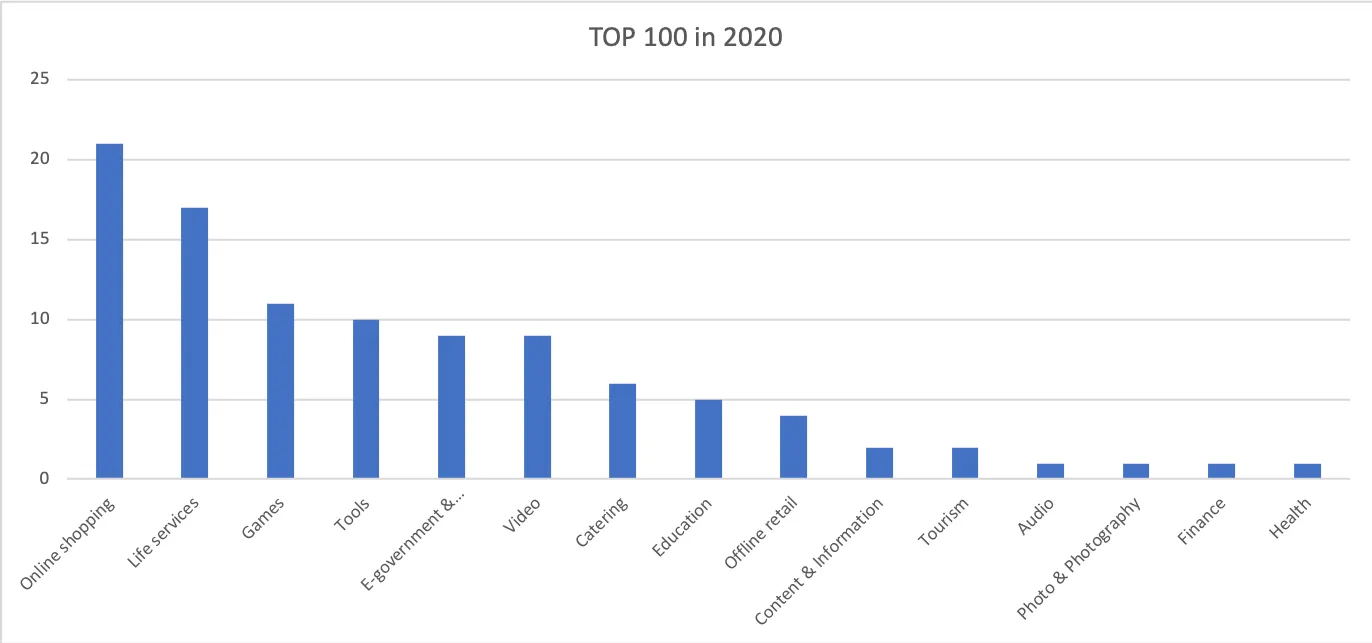
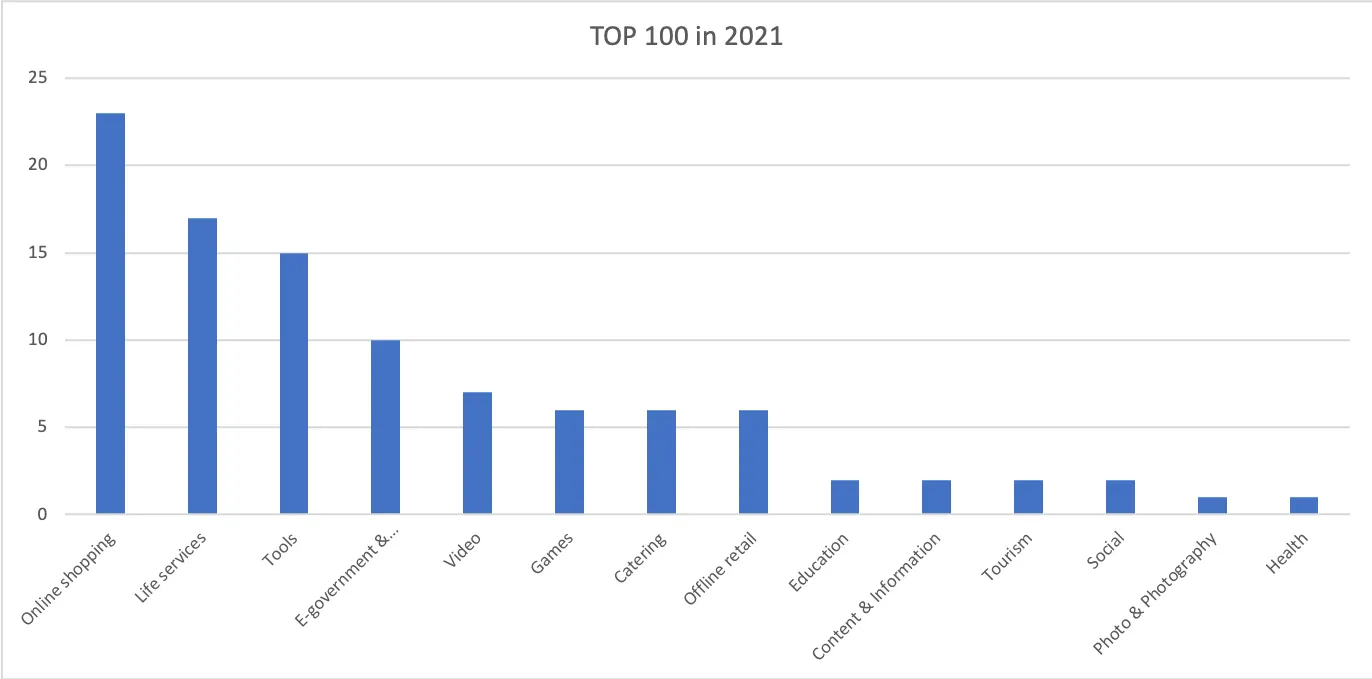
What Did the Mini Program Top 100 Show in 2020 and 2021?
To analyze the trends, we reviewed the monthly mini program TOP 100 index of Alading’s statistics platform for 2020 and 2021. The index combines four performance indicators (daily active users, sharing, length of stay and depth of visit) to cover the main stages of mini program use. At the time, it was a reference for mini program research in China.
Online shopping, life services and useful tools remained the three most popular categories, and filled about half of the list in most months. The other categories on the list were video, games, social, catering, content and information, e-government and public welfare, and offline retail.
About 20% of the list changed every month. In some months, e-government and offline retail mini programs, such as the State Council mini program, health codes, travel codes, grocery group buying and supermarkets, entered the list in large numbers or climbed in the rankings. This was linked to the Covid-19 outbreaks and lockdowns in Chinese cities.
What Were the Main WeChat Mini Program Trends?
In 2022, our analysis pointed to four trends.
Lower-Tier Markets
Mini programs had become popular in first- and second-tier cities, and had also built a strong user base in third- and fourth-tier cities, and even in counties. As big-city markets saturated and the leading mini programs strengthened their positions, competition and costs rose in large cities. More companies were expected to turn to lower-tier markets, where there was room to grow at a lower cost.
E-commerce, Retail and Livestream Shopping
E-commerce was clearly the most popular category in the mini program rankings. We expected e-commerce, livestreaming, retail, community group buying and tools to stay on top, with e-government and health services worth watching. At the time, WeChat was expected to open public traffic to e-commerce mini program livestreaming, which would make live shopping even more attractive to brands.
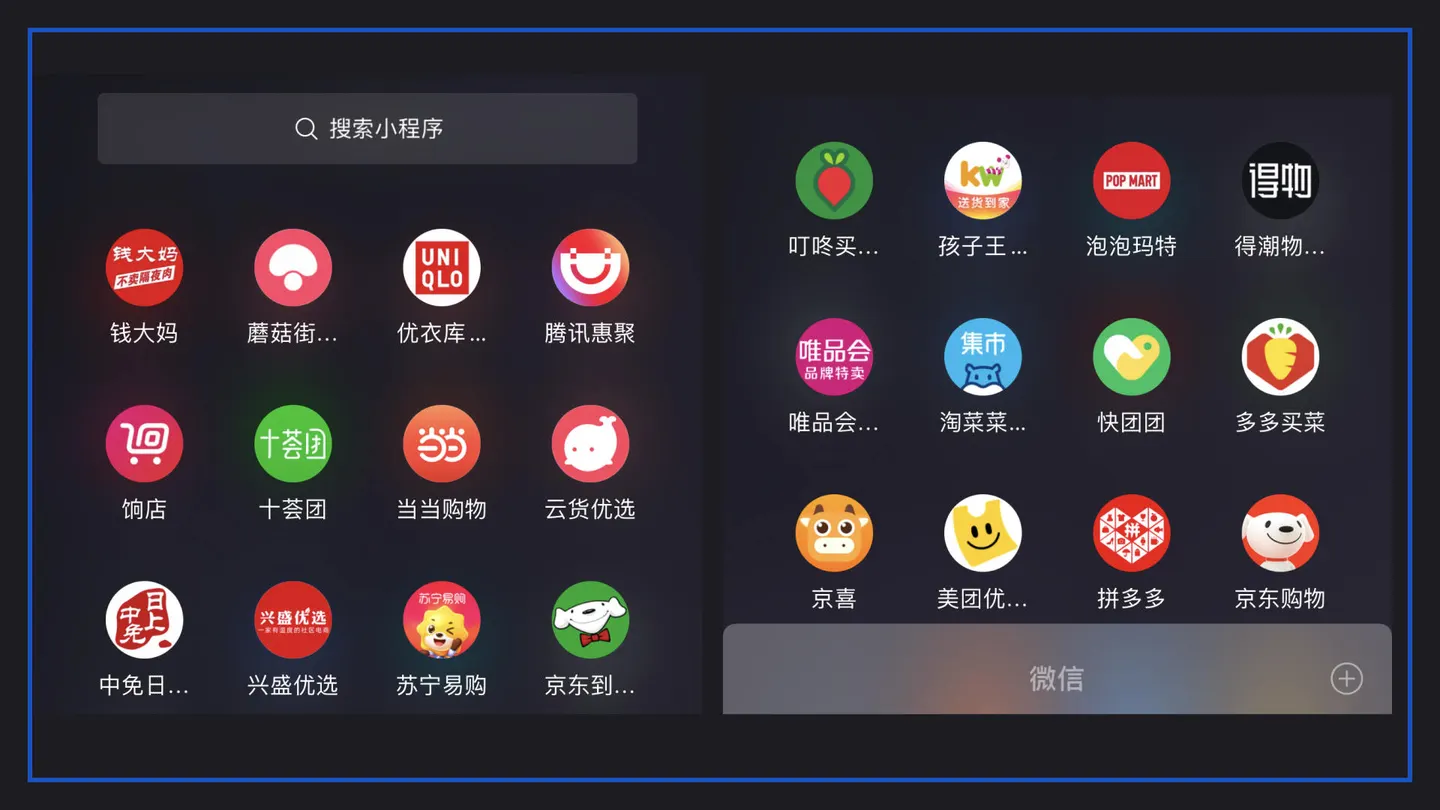
Mini programs for retail and community group buying, close to daily life, attracted the largest internet companies, which made competition tougher. During the Covid-19 outbreaks and lockdowns, they became essential tools to buy daily supplies, and e-government and health mini programs became necessary to go out.
Useful tools were also very popular, but their owners had to find ways to gain exposure and bring users back. Our advice at the time still applies: avoid a tool that is too narrow, add secondary functions around the core one or split them into separate mini programs that form a matrix, and use WeChat’s social features to spread.
Young people were a major audience. In the data we reviewed, users aged 18 to 29 made up 46.5%, 55.3% and 47.7% of the users of life services, catering and tourism mini programs respectively.
Private Traffic Pools and Refined Operations
Mini programs had become part of the private domain traffic infrastructure of brands, meaning the customers a brand can reach directly, without paying a platform each time. To move from buying traffic to keeping customers, a brand needed its own traffic pool, built through digital transformation and careful day-to-day operations.
That meant a matrix of WeChat products, each serving users in a different situation: mini programs, WeCom (the enterprise version of WeChat), WeChat Channels, mini program livestreaming and Official Accounts. Social marketing and customer management had become key to brand growth, and we expected refined operations and brand building to be the main focus of every mini program.
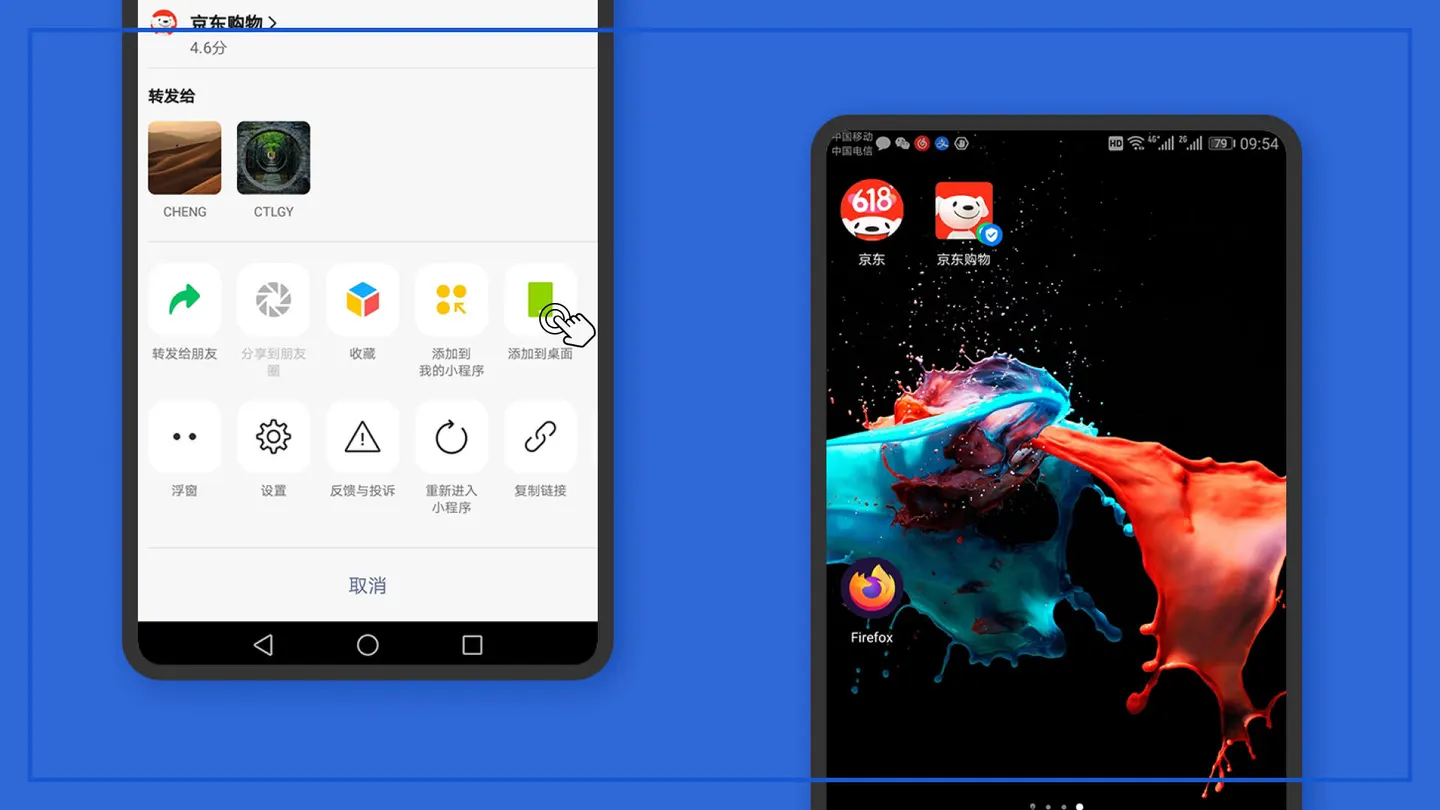
Home Screen Shortcuts on Android
Android users can add a mini program to their phone’s home screen, as Tencent’s help center explains. Like an app, the shortcut opens the mini program directly, without going through WeChat’s list of mini programs, and users are back on the home screen when they leave.
What Has Changed by 2026?
The trends of 2021 have largely played out, and Tencent’s own figures show the scale mini programs have reached:
| Period | Official figure | Source |
|---|---|---|
| 2019 | Over 300 million daily users, RMB 800 billion of transactions | Tencent, January 2020 |
| 2021 | Over 450 million daily users, 41% more active mini programs than in 2020 | Tencent, January 2022 |
| 2024 | RMB 8 trillion in GMV facilitated by mini programs | Tencent, Weixin and WeChat page |
| April 2026 | Over 1.1 billion monthly active users | Tencent, April 2026 |
Three changes matter most for brands:
- Commerce in WeChat is now an advertising business too. In its results for the second quarter of 2026, Tencent says that closed-loop marketing in the Weixin ecosystem helps services such as Mini Shops and Mini Games advertise more effectively, one of the drivers of its marketing services revenue.
- Mini programs serve cross-border business. In the April 2026 announcement, Tencent says the mini program ecosystem expanded to 100 countries and regions in 2025, across 108 industries, with cross-border transaction value up more than 70% year on year.
- Compliance is part of the project. Since 2023, the app filing rules of China’s Ministry of Industry and Information Technology also cover mini programs, which are filed through the platforms that distribute them.
What Should Brands Do with These Trends?
The trends of 2021 still give useful lessons for a mini program project in 2026:
- Design for the whole country, not only for the largest cities.
- Plan commerce from the start: product pages, WeChat Pay and live shopping.
- Build your private traffic by connecting the mini program with your Official Account, WeCom and WeChat Channels.
- Measure what users do, with tools such as WeData, to improve pages and campaigns.
To turn these lessons into a mini program for your brand, our mini program development team in Shanghai can help you scope and build it.
References of the 2022 analysis:
- 2021 White Paper on Mini-Program Internet Development, Alading
- Popularity Rankings: https://www.aldzs.com/viewpointlist
- An analysis of mini-program number, active users and financing in China in 2021, www.chyxx.com
- A tentative analysis of current developments and future trends of mini-program, doc88.com
Frequently Asked Questions
When were WeChat Mini Programs launched?
WeChat Mini Programs were officially launched on January 9, 2017. Tencent celebrated their third anniversary on January 9, 2020, when they already had over 300 million daily users. Their number passed 1 million by July 2018, and Tencent reported over 1.1 billion monthly active users of mini programs in April 2026.
What are the latest WeChat Mini Program trends?
In 2026, Tencent highlights commerce and advertising inside the Weixin ecosystem: Mini Shops and Mini Games advertise through its closed-loop marketing tools. Mini programs also serve cross-border business, in 100 countries and regions in 2025. For brands, the priorities remain e-commerce, private traffic and measuring what users do.
How can a brand grow its private traffic pool on WeChat?
A brand grows its private traffic, the customers it can reach directly, by connecting several WeChat tools: an Official Account for content, a mini program for services and sales, WeCom for direct contact with customers and WeChat Channels for video. Each tool serves a different moment of the customer relationship, and the mini program turns attention into purchases.