Baidu SEO in China 2026: The Complete Guide
Updated on |By QPSoftware
Baidu SEO is the work of making a website rank on Baidu, China’s largest search engine. It builds on the basics of Google SEO, but Baidu favors pages in simplified Chinese, fast hosting in mainland China with an ICP license, mobile pages that load within two seconds, fresh original content and links from Chinese websites.
Key takeaways
- Baidu is the primary target of SEO in China: it sent 59.26% of search referrals in China in August 2026, far ahead of Bing (18.92%).
- Write in simplified Chinese, optimize your homepage and titles, and publish fresh, original content: Baidu’s algorithms penalize scraped content and misleading titles.
- Host in mainland China with an ICP license when you can. Baidu warned in 2017 that Chinese websites hosted abroad would have display problems in its results.
- Speed and mobile matter: since October 2017, Baidu’s Lightning algorithm has favored mobile pages whose first screen loads within two seconds.
- Baidu now adds AI-generated summaries to its results pages: clear pages that answer questions directly have a better chance of being used.
This guide was first published in December 2017 and fully updated in April 2026. Its facts and sources were checked again in September 2026.
China is the world’s second largest economy, with more than a billion potential customers. By the end of 2025, China had 1.125 billion internet users, a penetration rate of 80.1%, according to the 57th Statistical Report on China’s Internet Development of the China Internet Network Information Center (CNNIC). For businesses with websites aimed at China, that is an audience no other single market can match.
For online entrepreneurs, the Chinese market is an unmatched opportunity, and a great challenge. In China, as in every other country, effective SEO is key to good positions in search engines, more traffic to your website and new clients or customers.
If you are thinking about doing SEO in China, the challenge is that the rules differ from the rest of the world. If you are a Western SEO expert, your knowledge is a good starting point. But if you want to improve your positions in search results and increase the traffic to your website in China, you need to approach SEO differently.
Google search is not available in mainland China. Here, the company that sets the SEO rules is Baidu, the most used search engine in China, and a different company calling the shots inevitably affects your marketing strategy. Adapting a website to those rules is the job of a Baidu SEO agency.
Which Search Engines Matter for SEO in China in 2026?
Baidu is the primary target of any SEO campaign in China. It sent 59.26% of search referrals in China in August 2026, and 73.49% on mobile, according to StatCounter. The other search engines used in China are:
- Bing: 18.92% of search referrals, mostly on desktop. Microsoft Bing is accessible without a VPN and used by a segment of professionals and international-facing businesses.
- 360 Search (so.com): 6.48%. Operated by Qihoo 360, it is stronger on desktop than on mobile.
- Sogou: 2.25%. Formerly China’s second largest search engine, Sogou has been wholly owned by Tencent since September 2021. It still runs, and it can search WeChat articles, but its share is now small.
- Shenma: a mobile search engine launched in 2014 by Alibaba and UCWeb, a mobile browser company.
- Toutiao Search: ByteDance’s search, built into Jinri Toutiao and Douyin, reaches younger mobile users who discover content through short-video feeds.
Google (1.41%) is blocked in mainland China. Our guide to Chinese search engines compares all of them in detail.
So what are the major differences between Western and Chinese SEO, and what is the most effective way to run an SEO campaign in China? The sections below answer these questions and others, to help you understand how to do SEO in China.
Baidu vs Google: How Different Are They?
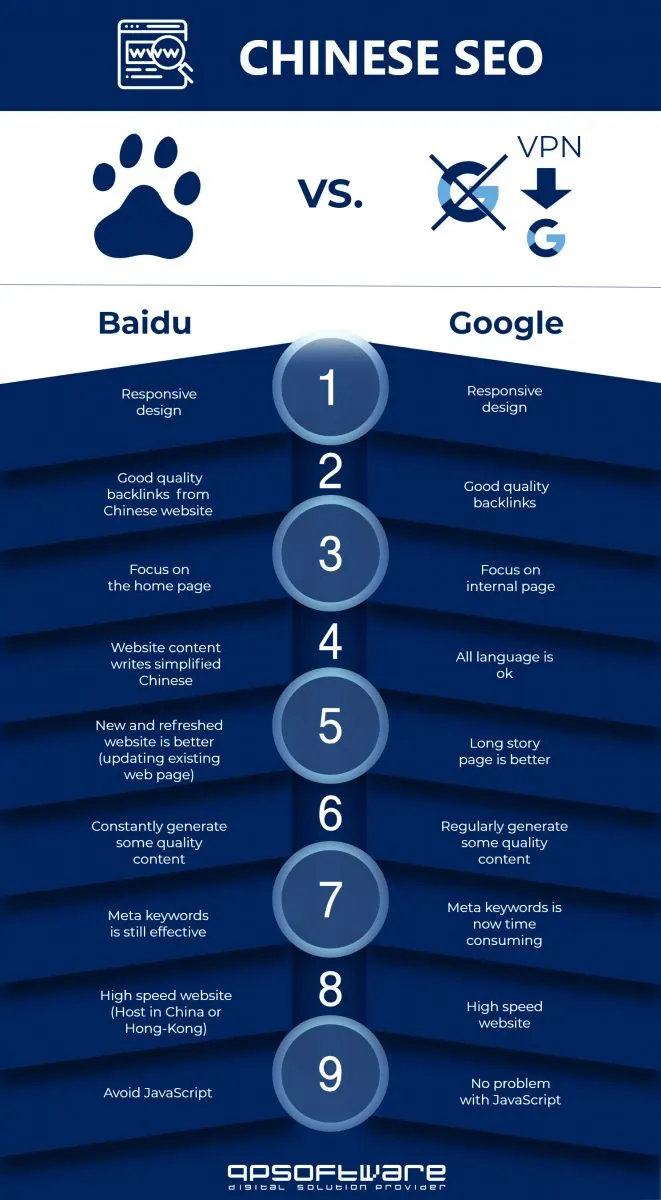
The two search engines are similar in many ways, but Baidu has unique characteristics that you need to know if you want to increase the traffic to your website.
Baidu Webmaster Tools
First of all, Baidu has its own search console, Baidu Webmaster Tools, now called the Baidu Search Resource Platform. You will need to read Chinese to master it, since it has no English version. With it, you can submit your website and your sitemap to Baidu, check how Baiduspider crawls your pages, see the keywords you rank for, and much more.
Our step-by-step guide explains how to submit your URL to Baidu:

The Homepage
Another difference has to do with the organization of your website content. While Google places more importance on internal pages, Baidu tends to focus on your homepage instead. Make sure your homepage is especially well optimized if you want to increase the traffic to your website.
Chinese Is Key for Baidu SEO
Another important factor to keep in mind is that Baidu is not very good at reading languages other than simplified Chinese. If you are aiming for good positions on Baidu to attract new clients or customers, your website content must be in simplified Chinese.
Baidu SERP Features
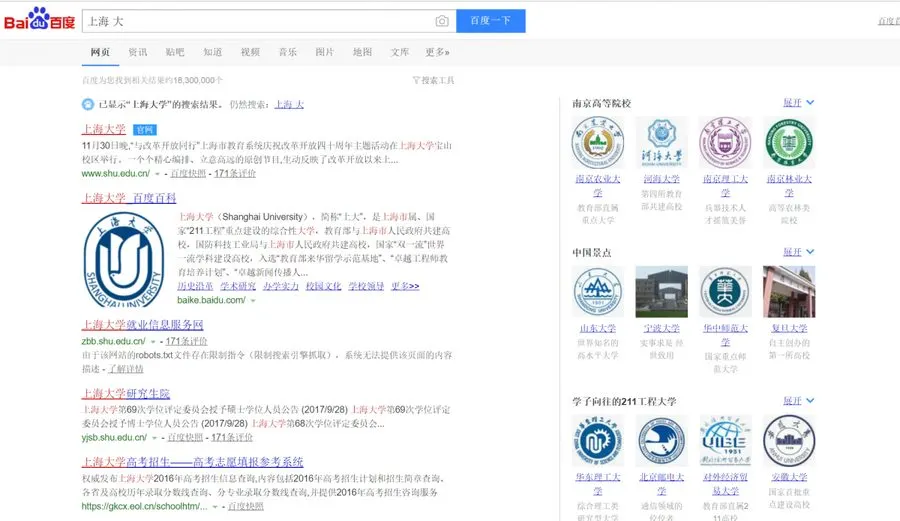
Baidu’s results page differs from Google’s in many aspects. In broad terms it shares Google’s two-column layout, but it also displays many rich results and result types. The most common ones are:
Baidu Baike
The Chinese counterpart of Wikipedia. Its entries appear on the results page the way Wikipedia results tend to appear on Google.
Baidu Maps
Displays map results related to your search, with additional information such as reviews, prices and comments.
Baidu Zhidao
Shows answers stored in Zhidao, Baidu’s questions and answers portal.
AI-Generated Summaries
In 2025, Baidu upgraded its traditional results page to a new format that gives users AI-generated summary answers, according to CNNIC. The section on Baidu AI below explains what this means for SEO.
How Important Is Content on Baidu?
No doubt you have heard that content is king, and that holds true for Baidu too. But while Google prizes pages that have a long history, Baidu places greater value on new and refreshed content. To run a successful digital marketing campaign in China, you need to generate new content constantly. You should also spend some of your energy updating existing pages, or Baidu will eventually overlook them.
A word of caution: it is a common belief that Baidu only cares about the freshness of your content, not its quality. Given that, many website owners simply copy and paste content from other sites, thinking it will be enough to rank. That strategy might have worked once. But Baidu has evolved: since July 2017, its Hurricane algorithm has targeted websites whose content mainly comes from scraping, and removed scraped pages from Baidu’s index. Copy and paste is not an option anymore unless you want to risk penalties. Baidu’s quality content guide, published in 2020, describes what it expects instead.
Keyword Research for Baidu

Search Suggestions and Related Searches
They are a good starting point to get ideas for your SEO campaign in China. Search suggestions and related searches are easy to find on Baidu’s results page. Collecting them takes time, but they give you valuable long-tail keyword ideas.
Baidu Keyword Planner
It is the Chinese counterpart of Google Keyword Planner. This tool is designed for marketers who research keywords for Baidu’s pay-per-click ads, but SEO professionals can also find useful data and keyword ideas in it for their keyword research in China. It is part of Baidu’s advertising platform, so you need a Baidu advertising account to use it.
Long-Tail Keywords Rank High on Baidu
As Baidu’s results page is covered with rich results in the first positions, ranking organically for broad topics and short keywords can be hard. If you target long-tail keywords, you have a higher chance of reaching the top of the page.
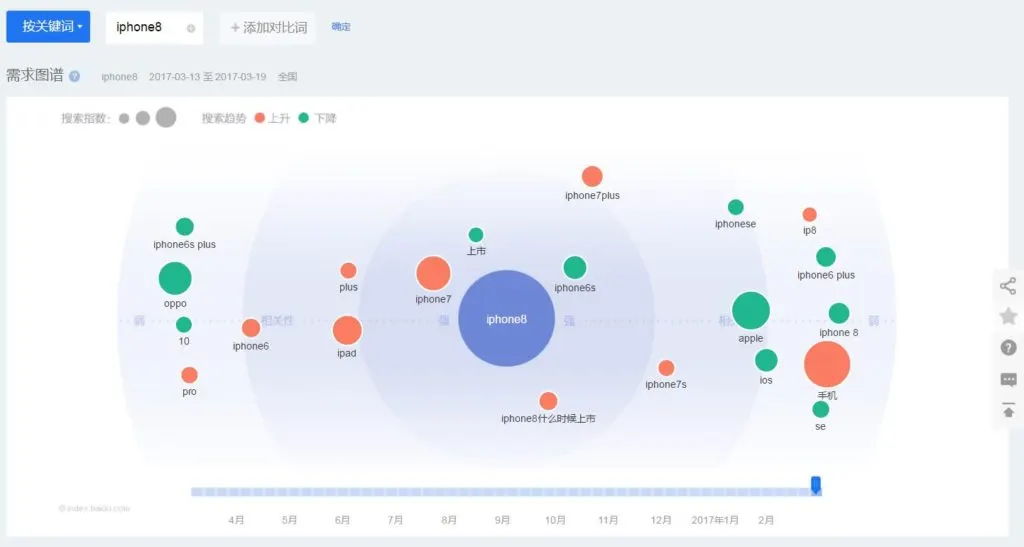
Baidu Index
It works like Google Trends: with Baidu Index, you can easily gather information about the hot topics on the Chinese internet. Baidu Index also provides visualization tools that ease your keyword research for the Chinese market.
Meta Keywords Are Useful
Keyword research is fundamental to every Google SEO campaign, and the same applies to Baidu. On Google, the meta keywords tag no longer affects your ranking, but Baidu still considers it relevant. Optimize your website, especially the homepage as mentioned above, by placing your most relevant keywords in titles, headings, metadata, the URL and so on.
Avoid Keyword Stuffing and Misleading Titles
Baidu is sensitive to keyword stuffing, so insert keywords into your content in a way that sounds natural. Titles need the same care: Baidu’s Qingfeng algorithm, launched at the end of September 2017, penalizes pages whose titles are written to deceive users and get clicks.
How to Do Link Building in China?
As with Google, backlinks play a key role in building your domain authority (DA). Over the years, Baidu has made its algorithm more like Google’s. In the past, any backlink would boost your authority and help you rank: quantity mattered more than quality.
How to Get Backlinks in China to Rank on Baidu
Today, Baidu looks for high-quality backlinks, so that is what you need to look for too. A few backlinks from websites with good authority and relevant content are better than a large number of backlinks from low-quality or irrelevant sites. Baidu also gives preferential treatment to backlinks from Chinese websites, so do not spend too much energy on backlinks from foreign websites: they will not help you improve your ranking or attract new customers.
Is Site Speed Relevant to SEO in China?
The answer is a resounding yes. Since its Lightning algorithm went live in early October 2017, Baidu has favored mobile pages whose first screen loads within two seconds, and demoted pages that take three seconds or more. If you want good positions on Baidu, select a hosting service that guarantees high performance in China. A CDN with nodes inside mainland China is one of the most effective ways to reduce load times, and Baidu itself recommends CDN acceleration: read our guide on how to optimize your site speed in China with a CDN.
Do I Need to Host My Website in China to Rank on Baidu?
The best practice is to host your website in mainland China, but that can prove difficult for foreign companies. In October 2017, Baidu warned that Chinese websites hosted on servers abroad would have display problems in its search results. To host your website in China, you need a Chinese business license, which in turn entitles you to apply for an ICP license, a requirement for every website hosted in mainland China.
Our complete ICP license guide gives all the details:

If you are not in a position to obtain these documents, you can take a shortcut, such as hosting your website in a neighboring region, preferably Hong Kong. Given Baidu’s warning, it is not a perfect solution, but a server close to mainland China usually loads faster there than a server on another continent.
How Does Responsive Design Affect SEO in China?
In China, people go online on their phones far more than on computers: in December 2025, 99.6% of internet users used a mobile phone to go online, against 32.5% for desktop computers, according to CNNIC. If you want to enter the Chinese market and attract new clients or customers, your website must be optimized for mobile devices.
Baidu’s Mobile Rules: Mobile Friendly and Ice Bucket
In December 2015, Baidu published its Mobile Friendly standard, together with a testing tool: mobile pages that meet it get preferential treatment in rankings, and pages that do not may be transcoded by Baidu. Baidu’s Ice Bucket algorithm, updated several times, penalizes mobile pages that get in the way of users. Version 3.0, in July 2016, targeted pages that force visitors to open an app, and version 5.0, in November 2018, covered landing page ads, app prompts and “expand full text” buttons in the Baidu App.
Aside from SEO, if your Chinese audience cannot browse your website easily on their phones, you will see a high bounce rate, and visitors will have no reason to return to your site.
Common Baidu SEO Errors to Avoid

As you can see, Google and Baidu have a lot in common, and Baidu tries hard to align itself with Google. As a general rule, whatever techniques you would avoid on Google, avoid them in your SEO campaign in China too.
But there are a few specific things to avoid if you want good positions in search results and more traffic to your website.
Flash Is Dead: Move On
Adobe stopped supporting Flash Player on December 31, 2020, and has blocked Flash content from running since January 12, 2021. If your website still has any Flash elements, remove them immediately: they will not load for any visitor, and they hurt your user experience and your rankings.
JavaScript: Use With Caution
The situation with JavaScript has improved since Baidu introduced its rendering crawler, Baiduspider-render, in 2017, but Baidu still handles JavaScript differently from Google. When the rendering crawler rolled out, Baidu advised site owners not to load valuable content with JavaScript. As a general rule, any content that is critical to your SEO (headlines, body text, metadata, internal links) should be fully present in the raw HTML, not loaded with JavaScript. For China websites built with React or Vue.js, server-side rendering (SSR) is the safest approach.
Baidu AI and the Future of Search in China
In 2023, Baidu launched ERNIE Bot (文心一言), its answer to ChatGPT, and it has been integrating AI-generated answers into its search results pages. In 2025, according to CNNIC, Baidu upgraded its traditional results page to a new format that gives users AI summary answers. This mirrors what Google is doing with AI Overviews, and it has significant implications for SEO in China.
AI is also changing how people use search engines. CNNIC counted 782 million search engine users in China in December 2025, 69.5% of internet users, against 79.2% a year earlier, and it links the decline to AI search products that answer questions directly. In September 2026, Baidu also announced an AI traffic analysis report in its Search Resource Platform, which will show how often a site’s content is cited, displayed and clicked in AI answers.
Pages that are authoritative, clearly structured and that answer specific questions directly are more likely to be referenced in these AI-generated summaries. The classic advice (clear headings, in-depth content, answers that match user intent) is more important than ever on Baidu, not less.
Why HTTPS Matters for Baidu SEO
Baidu has pushed websites toward HTTPS since 2017. In May 2017, it advised HTTP websites to switch to HTTPS to reduce the risk of hijacking, and upgraded its HTTPS certification tool: once a site is certified, Baidu crawls and displays its HTTPS links first. In August 2017, Baiduspider also started crawling HTTPS pages more actively.
If your China website still runs on HTTP, switching to HTTPS is one of the fastest technical SEO wins you can make. Redirect every HTTP address to its HTTPS version with a 301 redirect, and update all internal links and canonical tags to avoid redirect chains that slow down Baidu’s crawler.
Is Google Important for SEO in China?
You might assume that since Google pulled its search engine out of mainland China, there is no reason to spend any of your SEO efforts on Google.
In reality, some Chinese users still prefer Google and reach it through a VPN: Google had 1.41% of search referrals in China in August 2026. So do not forget about Google altogether during your SEO campaign in China: it can still attract new clients or customers to your website.
How to Reach Foreigners in China With SEO?
As mentioned before, VPNs are common in China, and many foreigners use one every day to reach their favorite social networks and sources of information. If you want them to find you organically, keep practicing good SEO on Google.
What Should You Do Next?
These are the core rules of Baidu SEO. However, if you want to succeed in the Chinese market, you need to go beyond technical SEO. Your strategy also needs to account for Chinese culture, platform ecosystems such as WeChat and Douyin, and the unique behavior of Chinese consumers. Consider complementing your Baidu SEO with Baidu paid advertising, and track its performance with Baidu Analytics (Tongji) to get the full picture.
Start with an audit of your website against the points of this guide: language, hosting and ICP license, mobile speed, HTTPS, content and links. Our Baidu SEO services cover the SEO audit, keyword research, content and indexing on Baidu, and our China SEO services for Baidu and Google also cover the Google side, with the help of China-based professionals who know this market from the inside.
QPSoftware can help you design a successful SEO campaign in China to increase the traffic to your website and improve its positions in Baidu’s search results. Contact us to start planning a strategy together.
Frequently Asked Questions
How do you do SEO for Baidu?
Start with a website in simplified Chinese, hosted in mainland China with an ICP license, or as close as possible, and fast on mobile. Verify it in the Baidu Search Resource Platform and submit your sitemap. Then research Chinese keywords, optimize your homepage and titles, publish fresh original content and earn links from relevant Chinese websites.
What are the best Baidu SEO tools?
The Baidu Search Resource Platform (ziyuan.baidu.com) is the essential one: site verification, URL and sitemap submission, crawl diagnosis, index volume and keywords. Baidu Index shows search trends, the keyword planner of Baidu’s advertising platform gives keyword ideas and search volumes, and Baidu Tongji measures the traffic of your website.
Do you need an ICP license for Baidu SEO?
You need an ICP license to host a website in mainland China, which is the best option for Baidu. Baidu can index a website hosted abroad, but in 2017 it warned that Chinese websites hosted on foreign servers would have display problems in its results. Hosting in Hong Kong is the usual compromise when you cannot get a license.
How is AI changing SEO on Baidu?
Baidu now shows AI-generated summary answers on its results pages, and CNNIC links the 2025 fall in search engine users to AI search products. In September 2026, Baidu announced a report that will show when a site’s content is cited in its AI answers. Clear, well-structured pages that answer questions directly are the best preparation.